
Many users assume “private currency” equals private use: that downloading any Monero app, or moving Litecoin into a wallet, automatically gives you perfect anonymity. That’s a persistent misconception. Privacy is a stack problem: protocol design, node behavior, network routing, key handling, device security and UX choices all combine to determine real-world leak surfaces. Selecting a wallet — particularly one that claims privacy and multi-currency support — is therefore a decision about which layers you control, which protections are automated, and which trade-offs you’re willing to accept.
This article compares three practical pathways for privacy-focused Americans who want a secure, usable way to hold Monero, Bitcoin and Litecoin: a Monero-native approach, a multi-asset privacy wallet with node and network options, and a hybrid hardware-assisted strategy. I ground the analysis in concrete mechanisms (key custody, network routing, coin control, shielding layers), clarify limits you should expect, and translate technical differences into decision heuristics you can act on today.
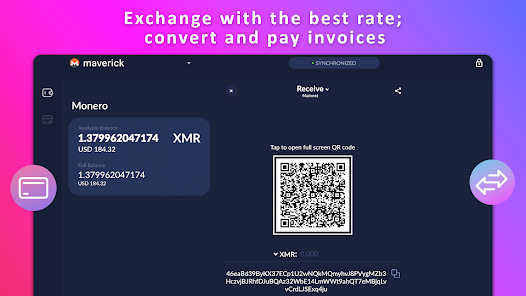
Three practical wallet archetypes and how they protect (or expose) you
At a high level, choices split along two axes: custody (who controls private keys) and network exposure (does your IP or node choice reveal data). I compare a Monero-specialist wallet, a multi-currency privacy wallet with advanced Bitcoin and Litecoin features, and a combined hardware + software workflow.
1) Monero-specialist wallet (Monero-first). Mechanism: Monero uses ring signatures, confidential transactions, and stealth addresses by protocol design. A Monero-first wallet that keeps the private view key on-device, supports background synchronization, and uses subaddresses preserves core Monero privacy properties while reducing UX friction. The key point: if the wallet never shares your private view key and allows connecting to your own node (or to Tor/I2P), it minimizes leaks from chain-level metadata and from remote node operators.
2) Multi-currency privacy wallet with node and network options. Mechanism: Some wallets combine Monero, Bitcoin, Litecoin, Zcash and others while offering Tor-only modes, I2P support, custom node connections, and non-custodial key storage. For Bitcoin this class may add PayJoin v2, Silent Payments, UTXO-level coin control and batching to disrupt typical on-chain heuristics. For Litecoin they may support MWEB (MimbleWimble Extension Blocks) to add a privacy layer. The value: you get convenience and cross-asset swaps, but you must inspect how each coin’s privacy primitives are implemented and whether defaults favor privacy or convenience.
3) Hardware-assisted hybrid (software + air-gapped or Ledger). Mechanism: Hardware devices hold the signing keys offline. Software wallets present the UX and network connectivity while delegating cryptographic signing to the hardware. This reduces risk from device malware and untrusted desktops but introduces workflow friction (air-gapped QR signing, recovery handling). When combined with Tor-only network routing and self-hosted nodes, this approach reduces both key-exfiltration risk and network fingerprinting.
Case study: what Cake Wallet-style feature choices mean in practice
To make these trade-offs concrete, consider a wallet that implements device-level encryption (Secure Enclave/TPM), keeps private view keys on-device (Monero-specific), supports Tor/I2P and custom nodes, offers PayJoin and Silent Payments for Bitcoin, MWEB for Litecoin, non-custodial architecture and hardware wallet integrations. That feature set moves you far toward resilient privacy—but it doesn’t eliminate all risks.
First, device-level encryption (Secure Enclave on iOS, TPM on Android) secures key material at rest and ties access to a PIN or biometric. This protects against casual device theft and many remote exploits, but not against sophisticated physical attacks or well-engineered malware that can intercept PINs or route approval prompts. Second, network-level protections like Tor-only mode and I2P proxy mask your IP, but they depend on correct configuration: a mis-set custom node, DNS leaks, or switching networks can expose metadata. Third, advanced Bitcoin privacy tools (PayJoin v2, Silent Payments, UTXO coin control) substantially reduce linkability, but they are not silver bullets—participants and infrastructure that don’t support these mechanisms will fall back to less private patterns, and on-chain analytic firms continue to develop heuristics that exploit timing or off-chain correlation.
Finally, multi-asset convenience features—built-in exchange, NEAR-Intents automated routing for swaps—are valuable but introduce trade-offs. A zero-telemetry, open-source, non-custodial wallet that uses decentralized routing reduces central points of failure, but cross-chain swaps expose counterparty and routing metadata to market makers and relayers. If your threat model includes powerful observers who can subpoena market makers or correlate swap timing, swaps may leak linkable information unless routed in a privacy-preserving way (for which the ecosystem is still maturing).
Where each approach breaks: limitations and threat-model boundaries
No wallet can deliver absolute privacy in every threat model. Important boundaries:
– Physical compromise: If an attacker controls your device and can observe passcodes or biometric inputs, hardware tokens help but are not infallible. Air-gapped workflows reduce this risk but at the cost of convenience.
– Network-level correlation: Tor obscures your IP from peers and nodes, but global network-level adversaries capable of observing both entry and exit traffic can still attempt timing correlation. I2P and custom nodes reduce reliance on public relays but cannot change this fundamental black-box correlation limitation.
– Cross-protocol linkage: Moving funds across chains (XMR → BTC or LTC, or vice versa) creates linkage opportunities unless steps are taken (mixing, time obfuscation, multiple hops). MWEB and Monero’s built-in privacy reduce on-chain linkability, but the act of swapping can create an observable event that adversaries can correlate.
– Ecosystem limitations: Not all services accept shielded addresses (Zcash mandatory shielding helps, but migration edge cases like incompatible seed phrases between wallet implementations exist). Known migration problems—such as needing to manually move ZEC from certain wallets—illustrate how UX and protocol choices can force privacy or operational trade-offs.
Decision heuristics: which wallet pattern fits which user
– You care almost exclusively about using Monero and maximal protocol privacy: prefer a Monero-first wallet that keeps the private view key local, supports subaddresses, and lets you run a full node or connect via Tor/I2P to trusted relays. If you are US-based and concerned about legal or service friction, self-hosting a node and using Tor reduces dependence on third parties.
– You want cross-asset convenience but still meaningful privacy: choose a multi-currency, non-custodial wallet that enforces device-level key security, offers Tor/I2P, provides Bitcoin privacy primitives (PayJoin v2, Silent Payments), and supports MWEB for Litecoin. Expect that swaps will require additional operational steps to minimize linkage (staggered timings, multiple liquidity sources, or on-chain pauses).
– You are protecting high-value holdings or face strong adversaries: add hardware isolation (Ledger, air-gapped Cupcake-style devices) and segregate coins across wallets based on threat profile. Use hardware for long-term cold storage and a separate hot wallet with strict limits for daily spending. This hybrid increases complexity but lowers catastrophic-exposure risk.
Practical, decision-useful checklist before you send funds
1) Threat model first: identify whether your concern is casual privacy, workplace scrutiny, law-enforcement level interest, or sophisticated network surveillance. The right wallet depends on this.
2) Check defaults: does the wallet default to privacy-protecting behaviors (Tor-only mode, mandatory shielding for ZEC, MWEB option enabled) or to convenience (cleartext nodes, public relays)? Defaults matter because most users keep defaults.
3) Verify custody: ensure private keys never leave your device unless you choose to export them. Prefer open-source software and verify the build if you can.
4) Use hardware for significant sums: combine Secure Enclave/TPM protection with an external device for signing large transfers.
5) Treat swaps as potential metadata leaks: if you swap XMR for BTC in-wallet, perform post-swap steps to break timing and address reuse correlations where possible.
FAQ
Is using Tor enough to hide my identity when transacting with Monero or Litecoin?
Tor significantly reduces your IP exposure to peers and nodes, and it is an essential layer for network-level privacy. However, Tor does not solve all linkage problems: if an adversary controls both your entry and exit points, timing analysis can still correlate activity. Additionally, cross-chain swaps and service-level metadata (exchange accounts, KYC) can re-link identities. Use Tor in combination with subaddresses, custom nodes, and operational precautions for stronger privacy.
Should I rely on a single multi-currency app for everything?
Single apps are convenient and can be privacy-respecting when correctly configured. The trade-off is that one compromise (malware, a misconfigured node, user error) can expose multiple assets. For many users a split strategy—hot wallet for small, frequent use; cold hardware for larger holdings—provides a pragmatic balance of safety and convenience.
How much does using MWEB on Litecoin help, and when might it not be sufficient?
MWEB adds a confidential-transaction style privacy layer to Litecoin, reducing visible amounts and improving linkability resistance. It helps most against chain-level heuristics but does not obviate network leaks or swap-related correlation. Adoption is still incomplete across services, so interoperability and liquidity for MWEB outputs can be limited—another instance where practical trade-offs matter.
What to watch next
Privacy tooling evolves in two directions: richer wallet-side primitives (PayJoin v2, Silent Payments, stronger coin control) and infrastructure improvements (broader MWEB use, better decentralized routing). Signals worth monitoring include wider adoption of PayJoin v2 among wallets and exchanges, improvements in decentralized swap routing that leak less metadata, and usability gains in air-gapped signing. These trends lower the operational cost of privacy; conversely, increased regulatory pressure on on-ramps or market-makers could push some private routing into more centralized channels, which would raise leakage risk.
In short: don’t treat any single app as a privacy panacea. Assemble the stack you need—non-custodial keys, device-level encryption, Tor/I2P, coin-control primitives, hardware signing—and match the workflow to your threat model. For users focused on Monero but who value multi-asset convenience, consider a wallet that explicitly protects the Monero view key on-device, supports background sync and subaddresses, and gives you Tor + custom-node options; examples and software that follow these rules make good starting points for experiments. If you want a practical next step, evaluate wallets by their defaults (privacy-first vs convenience-first), their open-source status, and their hardware integration options—then test with small amounts.
Finally, if you’re researching options and want to see a multi-currency, privacy-oriented implementation that combines Monero capabilities, Bitcoin privacy tools, and Litecoin MWEB support, review wallet documentation and source repositories carefully and test network behavior under Tor. For an accessible entry point to a non-custodial app that emphasizes Monero and multi-asset privacy, you can start by looking at this monero wallet implementation and comparing its defaults against the checklist above.